Close the Feed, Open Your Output: Why Mid-Edit Scrolling Is Silently Wrecking Your Work
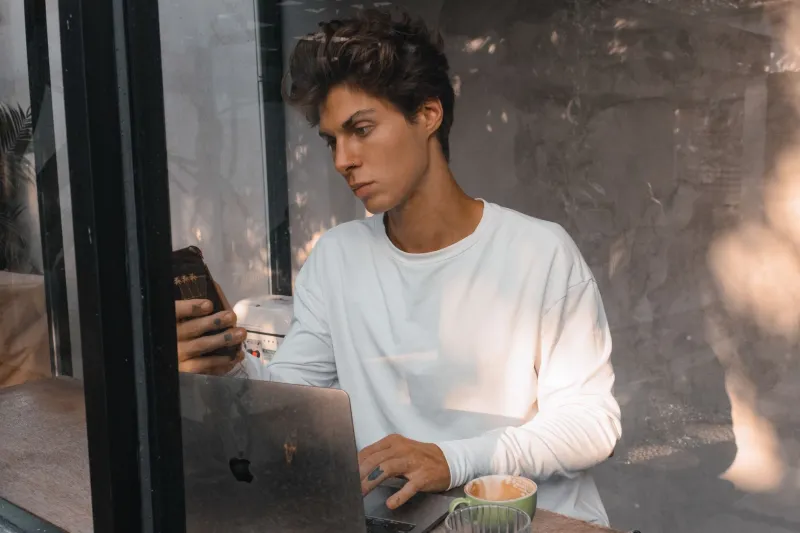
You're fifteen minutes into an editing session. Things are flowing. Then your phone buzzes — or maybe it doesn't, and you just reach for it anyway out of habit. You open Instagram. You scroll for what feels like a minute but is probably closer to eight. You put the phone down and go back to your image.
Something has shifted. The edit that felt right before the scroll now feels uncertain. You start second-guessing the color grade. You wonder if your style is even relevant anymore. The next twenty decisions take twice as long as they should.
This isn't a willpower problem. It's a neuroscience problem. And understanding it might be the most productive thing you do for your photography business this year.
What Context-Switching Actually Does to Your Brain
Human attention doesn't work like a light switch. When you shift focus from one task to another — say, from editing a portrait to scrolling a competitor's grid — your brain doesn't simply pause the first task and resume it cleanly when you return. It has to rebuild the mental context from scratch. Researchers call the time cost of this rebuilding an "attention residue."
Attention residue is exactly what it sounds like: the cognitive remnants of the interrupted task that linger after you've switched contexts. When you go back to editing after a scroll session, part of your mental bandwidth is still processing what you just saw — the images, the engagement numbers, the aesthetic choices other photographers are making. You're not fully back in your own creative headspace. You're operating at maybe sixty to seventy percent capacity.
For tasks that require sustained analytical thinking — like editing, where you're making dozens of small judgment calls per hour — that deficit compounds. Decisions get slower. Consistency drops. The internal creative voice that was guiding your choices gets drowned out by the noise of everything you just absorbed.
The Comparison Trap Is Worse Than You Think
The attention residue problem is real on its own. But for photographers specifically, mid-edit social scrolling carries an additional risk: real-time creative comparison.
When you pause your edit to check what other photographers are posting, you're not just losing focus — you're actively introducing external aesthetic standards into a decision-making process that should be entirely internal. Your eye was calibrated to your images, your style, your client's expectations. The moment you look at someone else's color grade or someone else's composition choices, you've recalibrated to a different target.
The result is often a kind of creative drift. Edits that would have felt cohesive start to feel uncertain. You start chasing a look you just saw rather than executing the look you already had in mind. Clients who hired you for your style end up with something that's a diluted version of three other photographers they follow.
One portrait photographer based in Austin described the pattern this way: "I'd open Instagram to 'take a break' and come back to my edit feeling like everything I was doing was wrong. It took me way too long to realize the break was the problem, not the edit."
The Friction Framework
The solution isn't pure willpower. Telling yourself to "just not check your phone" is roughly as effective as telling yourself to "just not think about a pink elephant." The more you try to suppress the impulse, the more mental energy it consumes — energy you need for editing.
The photographers who've successfully broken the mid-edit scroll habit have done it by building friction into the process. Not willpower. Friction. Small structural barriers that make the distraction slightly harder to access, which is enough to interrupt the automatic behavior before it becomes a full context switch.
Here are the friction tactics that working creators swear by:
Physical separation. Put your phone in a different room during editing sessions. Not face-down on the desk. Not in a drawer. A different room. The fifteen-second walk to retrieve it is enough friction to interrupt most impulse scrolls.
App timers with real consequences. iOS Screen Time and Android's Digital Wellbeing both allow you to set hard limits on specific apps. Set Instagram, TikTok, and any other feed-based app to zero minutes of availability during your editing window. When you hit the limit, the app locks. The lock is a speed bump — not a wall — but for most people, it's enough.
The Pomodoro hard stop. Instead of editing until you feel like taking a break and then reaching for your phone, schedule breaks deliberately using the Pomodoro method — 25 minutes of editing, 5 minutes of break. The key is that during the 5-minute break, you do something physical, not digital. Stand up. Stretch. Refill your coffee. The break refreshes your attention without introducing comparison noise.
Client-mode mental framing. Before you start an editing session, spend sixty seconds explicitly reminding yourself whose work you're editing and what their expectations are. This sounds almost too simple, but grounding your editing session in a specific client context makes external comparison feel less relevant. You're not editing for Instagram. You're editing for this person, with this brief, in this style.
What Happens When You Actually Stop
Photographers who've built real friction against mid-edit scrolling report a consistent set of outcomes. Editing sessions get shorter — not because they're rushing, but because decisions come faster when attention isn't fragmented. Style consistency improves across a gallery because the internal aesthetic compass isn't being reset mid-session. And perhaps most interestingly, they report feeling less creatively insecure overall.
That last point is worth sitting with. A significant chunk of creative self-doubt in photography isn't generated by the work itself — it's generated by the constant comparison loop that social media creates. Remove the comparison from the editing environment, and the work starts to feel more like your own again.
Speed in photography isn't just about editing tools or preset libraries or fast delivery systems. It's about protecting the mental state that makes fast, confident decisions possible. Every time you open Instagram mid-edit, you're not taking a break. You're paying a tax — in time, in focus, and in creative clarity — that you can't afford to keep paying.
Close the feed. Trust your eye. Finish the work.