Your First Edit Was Right: The Hidden Cost of Second-Guessing Your Creative Instincts
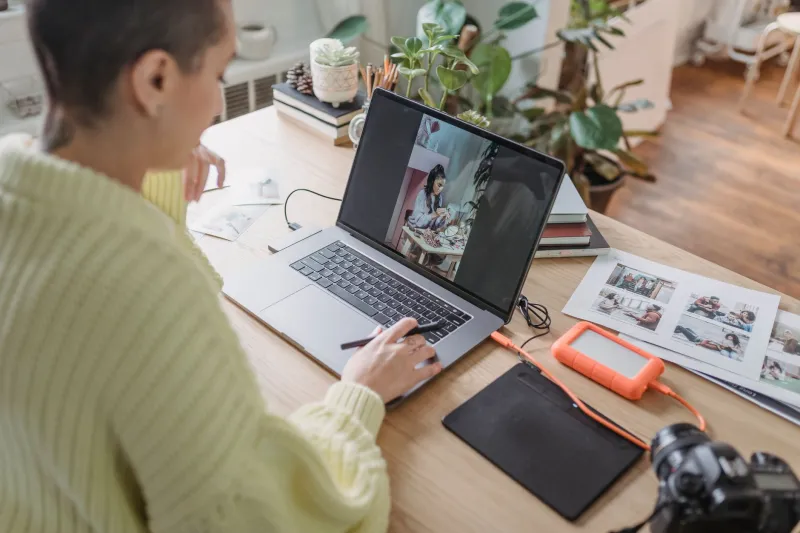
Here's a scenario that probably sounds familiar: You pull up a gallery, flag your hero shot, apply an edit you love, and then — for reasons you can't fully explain — you undo it. You try something different. Then something else. Forty-five minutes later, you're back to something that looks suspiciously close to what you started with, except now you're tired and vaguely annoyed at yourself.
This isn't a quirk. It's a pattern. And it's costing photographers real money.
The Revision Loop Nobody Talks About
Revision paralysis isn't just a time problem — it's a revenue problem. When you spend an extra two hours second-guessing a gallery that should've been done before lunch, you're not just burning daylight. You're pushing back delivery times, delaying client responses, and quietly signaling to your own brain that your instincts can't be trusted. That signal compounds.
Landscape photographer and content creator Dana Wills, based out of Portland, Oregon, figured this out the hard way. "I used to run every image through at least three rounds of edits before I'd even consider sending a proof," she says. "I thought I was being thorough. What I was actually doing was teaching myself to distrust every decision I made."
Wills eventually timed herself. The edits she agonized over for an hour? Clients chose them at roughly the same rate as the ones she knocked out in five minutes. The difference in client satisfaction was statistically negligible. The difference in her stress levels was not.
Why Your Brain Fights Your Gut
There's a reason the first edit often hits different. When you initially process an image, you're responding to it emotionally and visually at the same time — light, mood, composition all register before your analytical brain starts poking holes. That first impression is rich with instinct built from thousands of hours behind a camera.
Then the second-guessing kicks in. Suddenly you're thinking about what a client might want, what performed well on Instagram last week, what some tutorial said about warm tones versus cool tones. You're no longer editing the image in front of you. You're editing a hypothetical image for a hypothetical audience, and the work suffers for it.
Psychologists call this "analysis paralysis" — the more options and considerations you pile onto a decision, the harder it becomes to make one. For photographers, it shows up as endlessly cycling through color grades, tweaking exposure sliders by fractions of a point, or re-cropping an image six times before landing back on the original frame.
What Successful Creators Do Differently
The photographers who move fast and book consistently aren't making reckless decisions. They've just built systems that respect their initial instincts while giving them a clear checkpoint for when iteration is actually worth it.
New York-based wedding photographer Marcus Obi has a rule he calls "first flag, final flag." When he culls a gallery, whatever he flags in the first pass is what gets edited. Full stop. "I used to go back and re-cull after editing, which meant I was second-guessing decisions I'd already committed time to," he explains. "Now I trust the first flag. If I flagged it, there was a reason. I don't need to re-litigate that."
Obi says this single change cut his post-production time by nearly 30 percent — and his client satisfaction scores went up, not down.
Commercial shooter Priya Anand, who works out of Austin, takes a slightly different approach. She gives herself what she calls a "two-touch rule": one initial edit pass, one refinement pass, and then it's done. "The third touch is almost never about the image," she says. "It's about anxiety. And anxiety is not a good editor."
Building a Framework for Commit vs. Iterate
Not every edit deserves the same level of scrutiny. Part of moving faster is knowing which decisions actually benefit from iteration and which ones are just absorbing your energy without improving the work.
Here's a simple framework to start with:
Commit immediately when:
- The edit matches the mood you felt while shooting
- Your first reaction to the processed image is positive
- The technical fundamentals (exposure, white balance, sharpness) are solid
- You've edited similar content before and have a reliable baseline
Iterate intentionally when:
- The image is for a high-stakes deliverable (campaign hero shot, cover, print)
- Client feedback has explicitly indicated a different direction
- Something technical is genuinely off and needs correction
- You're working in a style that's new to you and you're still calibrating
The key word in that second column is intentionally. Iteration with purpose looks different from revision spiraling. One has a clear endpoint. The other doesn't.
The Speed-Quality Myth
There's a persistent belief in creative industries that slower equals better — that the more time you pour into something, the higher the quality ceiling. For photographers, that belief is particularly stubborn.
But the data doesn't really back it up. Faster editors who've built strong instincts over years of shooting tend to produce work that clients love just as much as the work of photographers who labor over every frame. The difference is margin — both time margin and profit margin.
When you're spending four hours on a gallery that should take two, you're not just losing time. You're compressing the space you have for your next shoot, your next pitch, your next creative idea. Speed, when it comes from confidence rather than carelessness, is a competitive advantage.
Getting Out of Your Own Way
The fastest thing you can do for your workflow today isn't a new plugin or a faster computer. It's deciding to trust the editor you've already become.
Start small. Pick one session this week and commit to a single edit pass. Flag it, edit it, export it. Notice what happens. Odds are, the work is good. Odds are, the client is happy. And odds are, you'll have a couple extra hours back that you can put toward something that actually moves your business forward.
Your first edit isn't a rough draft. Most of the time, it's the answer — and the sooner you believe that, the faster everything else gets.