The Ping Problem: Why Your Best Editing Happens When Nobody Can Reach You
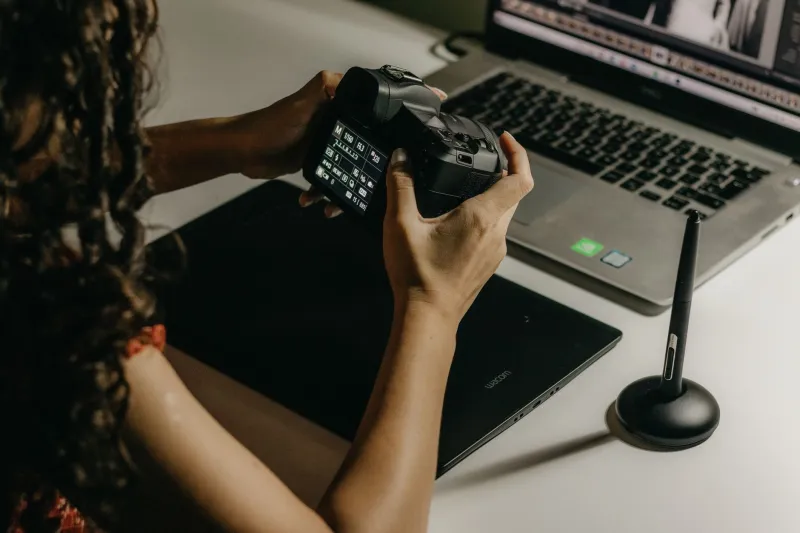
You're twenty minutes into an edit. The light in the image is almost there — you're dialing in the shadows, feeling the rhythm of the session, developing a visual instinct for the whole batch. Then your phone buzzes. A client asking about a timeline. A DM from someone asking your rates. A read receipt that somehow demands a response.
You glance at the screen for eight seconds. You look back at your monitor.
The rhythm is gone.
This isn't a minor inconvenience. It's one of the most underestimated productivity killers in creative work, and for photographers specifically, the cost shows up in ways that directly affect income, client satisfaction, and long-term creative development.
What the Research Actually Says
Gloria Mark, a professor at UC Irvine who studies digital distraction, has published extensively on the cost of workplace interruptions. Her research found that after a distraction, it takes an average of 23 minutes for a knowledge worker to return to full cognitive engagement with a complex task.
For photographers editing a 400-image gallery, that math is brutal. If you're interrupted three times during a two-hour session, you're not losing 24 seconds. You're potentially losing more than an hour of peak creative focus — spread across recovery periods you don't even notice happening.
And here's the part that stings for photographers specifically: editing isn't just a technical task. It's a perceptual one. Your eye develops momentum within a session. You start to see the light of a particular shoot, to feel the palette, to make consistent decisions faster because your brain has built a temporary model of what "right" looks like for this specific set of images. Interruptions don't just pause that process. They reset it.
The High-Volume Photographer's Secret
Talk to photographers who consistently deliver large-volume work on tight timelines — wedding photographers turning around 1,000-image galleries in 48 hours, commercial shooters delivering same-week for e-commerce clients — and a pattern emerges. Almost all of them have, through trial and error, landed on some version of the same solution: protected editing time with zero incoming communication.
Marcus Webb, a wedding photographer based in Nashville who shoots 40+ weddings a year, calls his blocks "dark hours." Every weekday from 7 AM to noon, his phone is on airplane mode, his email auto-responder is active, and his editing software is the only thing open on his computer.
"I used to answer every message as it came in," he says. "I thought that was being professional. What I was actually doing was delivering mediocre work slowly. Now I deliver better work faster, and my clients hear from me every afternoon like clockwork. Nobody's complained once."
That's the counterintuitive truth at the center of this conversation: being less available during your creative work doesn't make you a worse communicator. It makes you a more reliable one — because you're operating on a schedule rather than reacting to a feed.
The Asynchronous Communication Shift
The concept of asynchronous communication — responding to messages on a schedule rather than in real time — has been widely adopted in tech and remote work culture, but photography businesses have been slow to embrace it. Part of this is industry culture: clients expect quick responses, and photographers worry that slower replies signal disinterest or disorganization.
But the evidence from photographers who've made the switch tells a different story. When you set clear communication expectations upfront — "I respond to all messages between 1 PM and 5 PM, Monday through Friday" — clients don't interpret that as neglect. They interpret it as structure. And structure reads as professionalism.
The key is making the policy visible. A simple note in your client onboarding materials, your email signature, and your booking confirmation removes the ambiguity. You're not ignoring anyone. You're working.
Building Your Editing Window
Implementing this in practice doesn't require a dramatic lifestyle overhaul. It requires three things: a defined window, a clear boundary, and a communication system that covers the gap.
Define your window first. Look at your schedule and identify the two to four hours when your creative energy is consistently highest. For most people, this is morning — before the day's cognitive load accumulates. But if you're a night shooter or have family obligations in the morning, early evening can work just as well. The specific time matters less than the consistency.
Set the boundary with tools, not willpower. Relying on personal discipline to ignore notifications is a losing battle. Use what's available: iOS Focus modes, Android's Do Not Disturb scheduling, email auto-responders, and app timers. Remove social media apps from your editing device entirely if you need to. The goal is to make interruption structurally difficult, not just theoretically discouraged.
Create a communication bridge. An auto-responder that sets clear expectations does most of the heavy lifting here. Something like: "Thanks for reaching out! I'm currently in an editing session and will respond to all messages by [time]. For urgent shoot-day questions, please call [number]." This covers the rare genuine emergency while protecting your focus window from routine inquiries.
What Changes When You Go Dark
Photographers who've implemented structured editing windows consistently report the same cluster of outcomes:
First, editing speed increases. When you're not context-switching between a Lightroom catalog and your DMs, your decision-making per image accelerates. The cognitive overhead of re-engaging with the work after each interruption disappears, and you move through a gallery with a momentum that simply isn't possible in a fragmented session.
Second, consistency improves. The visual calibration you develop in the first twenty minutes of a session — the internal sense of tone, contrast, and color that makes a gallery feel cohesive — holds across the entire batch when you're not constantly breaking and re-entering that state.
Third, and maybe most importantly: the work gets better. Not incrementally. Noticeably. Photographers who review their output from focused sessions versus interrupted ones often describe the difference as obvious — sharper instincts, cleaner decisions, fewer images that need to be revisited.
Reclaiming the Creative State
There's something worth naming directly here, beyond the productivity math: editing is a creative act. Not just a technical pipeline. When you're doing it well, there's a state of absorption — sometimes called flow — where decisions feel intuitive and the work moves fast because you're fully inside it.
Notifications don't just slow you down. They make that state inaccessible. And if you've been editing with your phone on the desk for years, you may have forgotten what it feels like to work without that low-level hum of potential interruption running in the background.
Turn it off. Block the window. Close the feed.
The messages will be there in four hours. The creative state is only available right now.