From First Email to Final Gallery in Under Two Hours: How These Wedding Photographers Are Rewriting the Booking Playbook
The traditional wedding photography timeline looks something like this: inquiry comes in, you respond within a day or two, you schedule a consultation call, you send a contract, you wait, you follow up, you finally get a signed agreement three weeks later. Then you shoot. Then you edit for a month. Then you deliver.
For a growing number of photographers across the country, that timeline is starting to look embarrassingly slow.
We spent time with photographers who have engineered their entire client experience — from the first touchpoint to gallery delivery — into a window that fits inside a single morning. Here's how they're doing it, and what tools are making it possible.
Why Speed Matters More in Weddings Than Anywhere Else
Wedding clients are emotionally charged from the moment they get engaged. They're making a dozen big decisions simultaneously, and they're doing it fast. Research from The Knot consistently shows that couples contact multiple photographers at once — often five or more — and the first vendor to respond with a clear, confident offer has a measurable conversion advantage.
"Engaged couples are in a decision sprint," says Priya Chandra, a wedding photographer based in Chicago who books over 90% of her inquiries. "If I'm the first one to send a contract that's ready to sign, I'm already halfway there. If I make them wait three days for a response, I've already lost half of them."
Priya's intake-to-booking window? Under 20 minutes on average. She's not cutting corners — she's cut the friction.
The Automation Stack That Makes It Possible
The photographers compressing their client journey aren't superhuman. They've built systems. Specifically, they've connected a set of tools that handle the administrative layer automatically so they can focus on the creative work.
Here's a typical stack we encountered:
Inquiry capture: A highly optimized contact form (often built in HoneyBook or Dubsado) that collects date, venue, vision, and budget upfront. No back-and-forth needed to qualify the lead.
Instant response: A pre-written email sequence that fires within minutes of form submission. It's warm, personal-feeling, and includes a link to a pre-built proposal with pricing, packages, and an embedded contract.
E-signature and payment: Contracts through HoneyBook or DocuSign allow couples to sign and pay a retainer in the same session. No printing, no scanning, no PDFs lost in inboxes.
Pre-shoot templates: A questionnaire that goes out automatically after booking, collecting shot lists, family groupings, timeline preferences, and venue details. By the time the wedding day arrives, the photographer already knows everything they need.
The result: what used to take 10 emails and two phone calls now takes one form submission and a few clicks.
The Edit Side: Where the Real Time Compression Happens
Getting booked fast is one thing. Delivering fast is where the real magic — and the biggest competitive edge — lives.
Jordan Mills, a destination wedding photographer based in Denver, delivers full galleries within 24 to 48 hours of the wedding day. His secret isn't working through the night. It's front-loading every decision.
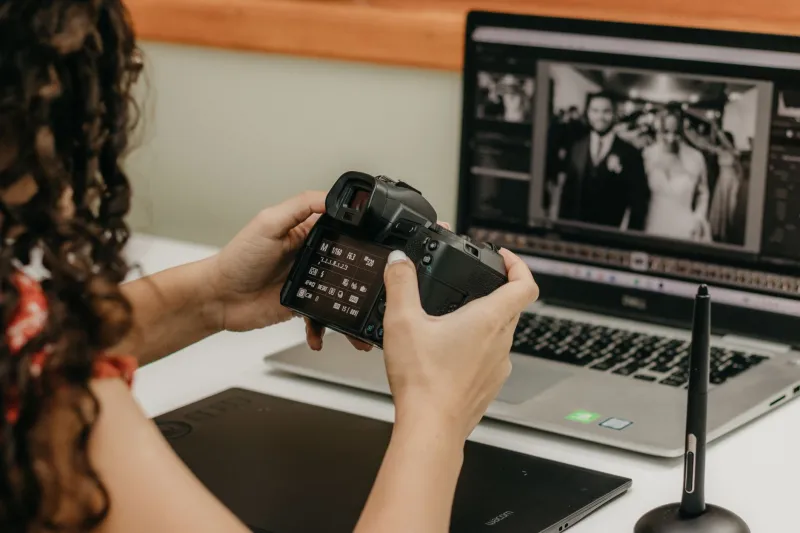
"I have a culling system that I run on the drive home from a shoot," Jordan explains. "I'm using Photo Mechanic to pull selects on my laptop before I even get back to my desk. By the time I sit down to edit, I'm already working with a curated set."
From there, Jordan applies a base preset to the entire gallery, makes exposure corrections in bulk using Lightroom's sync feature, and uses AI-powered tools for skin tone balancing and sky work. His hero shots — the images he knows the couple will post, print, and share — get individual attention. The rest get polished to a consistent, clean standard.
"Clients don't zoom into every image at 200%," he says. "They feel the gallery. They want it to feel cohesive and beautiful and fast. If I deliver in 36 hours and it feels great, I've won."
Pre-Shoot Templates Are the Unsung Hero
One element that doesn't get enough credit in the speed conversation is the pre-shoot template. These are detailed questionnaires and shot list documents sent to couples weeks before the wedding, and they eliminate an enormous amount of day-of friction.
When a photographer walks into a venue already knowing the must-have family combinations, the couple's favorite candid moments from their engagement shoot, and the timeline down to 15-minute increments, they move faster and make better decisions under pressure.
Several photographers we spoke with also send venue scouts via Google Maps Street View walkthroughs and virtual venue tours, so they arrive knowing where the light falls at 4 PM without needing an exploratory hour on the day itself.
What the Numbers Look Like
The photographers running this kind of compressed workflow aren't just delivering faster — they're booking more. Priya reports a 2x increase in booking rate year over year since implementing her rapid-response system. Jordan has a 60-person waitlist and no longer runs paid ads.
The through-line is simple: when the client experience is fast, smooth, and confident, clients trust you. And trust converts.
Building Your Own Compressed Workflow
You don't need to overhaul everything overnight. Start with one piece: automate your inquiry response. Then build your contract template. Then tackle your editing preset library. Each layer you add compounds the speed gain.
The tools exist. The templates are out there. The only thing between your current workflow and a 90-minute client experience is the decision to build it.